
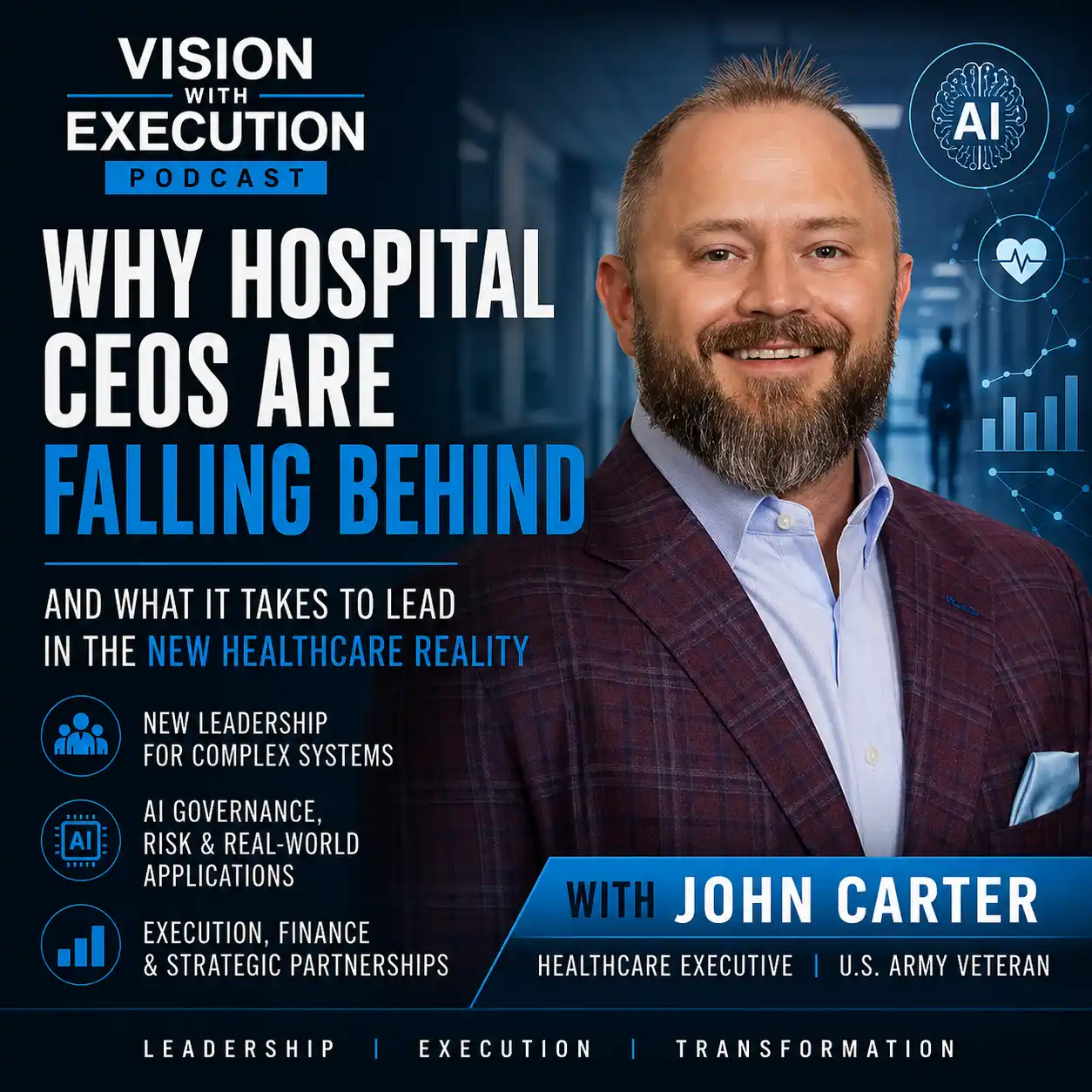
Why Hospital CEOs Are Falling Behind and What It Takes to Lead in the New Healthcare Reality
About this Podcast:
In this episode, I sat down with John P Carter of Pinnacle Healthcare Consulting, and honestly, this was one of those conversations where I walked away thinking differently about leadership in healthcare.
I went into this wanting to understand why healthcare leadership feels strained right now, and John immediately reframed it. He pushed back on the idea that leadership is failing and instead explained that the environment has changed faster than leadership models have.
That really set the tone for everything.
We spent a lot of time talking about what he called a “complex adaptive system.” At a high level, what that means is that nothing in healthcare operates in isolation anymore. A change in staffing impacts throughput, which impacts patient experience, which impacts revenue. Everything is connected, and outcomes are no longer linear.
Because of that, the old command and control style of leadership just does not work. Leaders can no longer assume they have the best information or that decisions should be centralized. What actually happens is decisions get delayed, frontline teams feel stuck, and performance suffers.
One of the biggest takeaways for me was this idea that too much control does not create order. It creates inertia.
Instead, John introduced the concept of decentralized execution. In simple terms, leaders need to create clarity and alignment at the top, then push decision making down to the people closest to the problem. The goal is not to control every decision, but to build a system where better decisions naturally happen across the organization.
We then shifted into AI, and this is where the conversation got really practical.
John made a point that stuck with me. AI in healthcare is not primarily a technology problem. It is a governance problem.
Most organizations are either chasing tools without a strategy or trying to layer AI on top of broken workflows. His advice was clear. Fix the system first, then scale it with AI. He emphasized governance, defined ownership, risk thresholds, and making sure there is always a human in the loop.
From there, we talked about partnerships and how leaders should think about private equity and external vendors. The way he framed it was simple. Partnerships are about speed and capability. You cannot build everything internally anymore, so the question becomes where to build, where to buy, and where to partner.
We closed with what might have been the most actionable part of the entire conversation.
I asked him what a CEO should do if they had 90 days to reset their organization. His answer was a simple three phase framework.
First is clarity. Define the vision and the true direction of the organization.
Second is alignment. Identify bottlenecks, break down silos, and get teams moving in the same direction.
Third is execution. Push decision making down, create autonomy within guardrails, and focus on outcomes.
That sequence stuck with me because it is simple, but it is not easy.
Overall, this episode reinforced something I think a lot of healthcare leaders are starting to feel.
The game has changed. And if your leadership model does not change with it, your organization is going to fall behind.
EndFragmentOur Partners


Comments